
In the late 1910s, there came a young boy from Ramnagara to live at our Lalbagh home while he attended the nearby London Mission School.
The Lalbagh house had been a hub of political activity, especially of the non-Brahmin leaders, who had begun the state’s first political party. The movement in Mysore then was on two fronts, regionally against the excesses of the princely Mysore government, controlled by the urban elite who were unrepresentative of the land’s population, as well as the British imperial government nationwide.
The boy’s name was Kengal Hanumanthaiah. Four decades later, he would become the second Chief Minister of the erstwhile Mysore state and the visionary behind the iconic state legislature building, the Vidhana Soudha, and then later a Union Government Minister.
In the decades before independence, Mysore was undergoing rapid change. No doubt that it was here that Hanumanthiah was inspired by the non-Brahmin leaders, who he would later come to join, and whose party would eventually merge into the Mysore faction of the Indian National Congress. Before this, Hanumanthaiah also pursued a law degree in Poona, then part of the Bombay Presidency, a seat of radical Indian nationalism. These early encounters with reformist thought and nationalist ideals profoundly shaped his political outlook.
Once back in Mysore, he entered politics, and soon earned a reputation as a man of strong personality and a sharp tongue. In an era of supposed gentle statesmanship, he stood out for his outspoken nature, which often made it difficult for him to gain acceptance within the inner circles of the Mysore Congress. Persistence, however, saw him rise through the ranks, and his long political career would be marked by both achievement and controversy.

Heralding a New Mysore: Kengal Hanumanthiah, second from left. On the far left, the then Maharaja of Mysore, and on the right, former Dewans of Mysore, Sir M. Visvesvaraya and Sir Mizra Ismail.
A few memorable incidents include, in 1946, when Hanumanthaiah publicly criticized the Maharaja of Mysore, he was hit with a sedition charge that resulted in an 18-month prison sentence. When freedom dawned in August of 1947, the future Chief Minister of Mysore was in the Bangalore Central Gaol.
Even in independent India, under Prime Minister Jawaharlal Nehru, Hanumanthaiah was unafraid to openly challenge and criticise the country’s leader, despite them belonging to the same party – something rare in the India of today. He was also supposed to have not toed caste lines. This became most apparent during the campaign to merge Mysore with other Kannada-speaking regions, a move that created the new state of Karnataka.
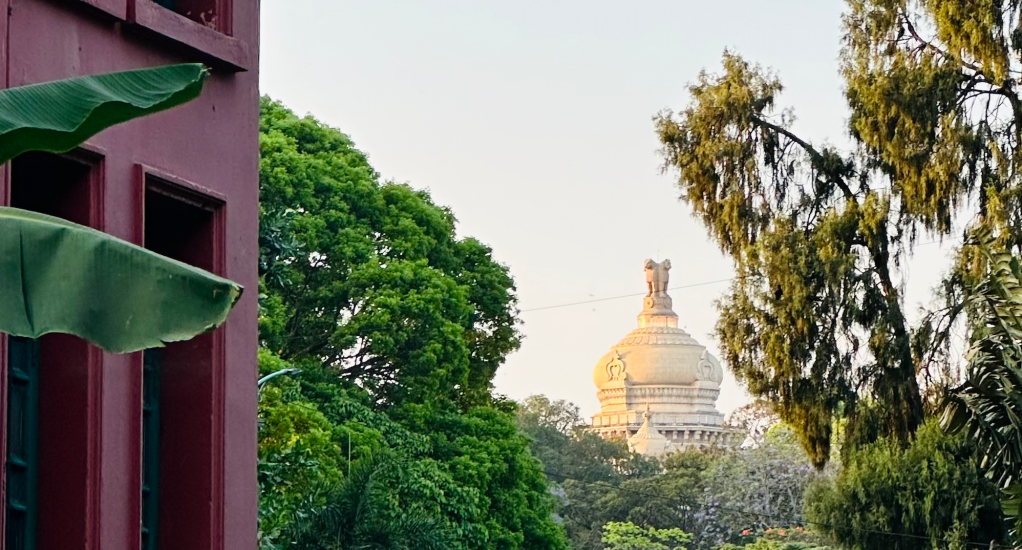
In the 1950s, an unexpected remark from a visiting Russian delegation would change the course of his legacy. Observing that Bangalore’s government buildings bore only the stamp of colonial architecture, they asked him if the city had no style of its own. Hanumanthaiah seized on this criticism and resolved to create a legislature building that reflected Indian identity. He scrapped the previous government’s modest plans and instead commissioned the grand Vidhana Soudha, a monumental structure built at a far higher cost, but infused with Indian architectural ethos.
Ironically, Hanumanthaiah himself never stepped foot as a Chief Minister into the new legislature, as it was finally inaugurated by his successor, Kadidal Manjappa. Yet the structure remains as his enduring legacy and symbol of state pride, upon which he had the words, “Government’s Work is God’s Work” inscribed.
Today in Lalbagh, the brief years he spent there as a young boy is remembered by a road and circle named in his honour.
Resources:
James Manor, ‘Kengal Hanumanthaiah in Mysore: The Style and Strategy of Individual Leadership in the Integration of a Region’s Politics’ (1974) 4(1) South Asia: Journal of South Asian Studies 21.
Janaki Nair, ‘The “Composite” State and Its “Nation”: Karnataka’s Reunification Revisited’ (2011) 46(47) Economic and Political Weekly 52.

 prithvika prasad
Leave a comment