
Growing up, my father and I bonded over World War history. More than the number of war movies we’ve watched together, it would probably be easier to count the ones we haven’t. It was maybe over 15 years ago now, when watching one of these movies, I was surprised to hear mention of a certain Bangalore Torpedo by an American soldier.
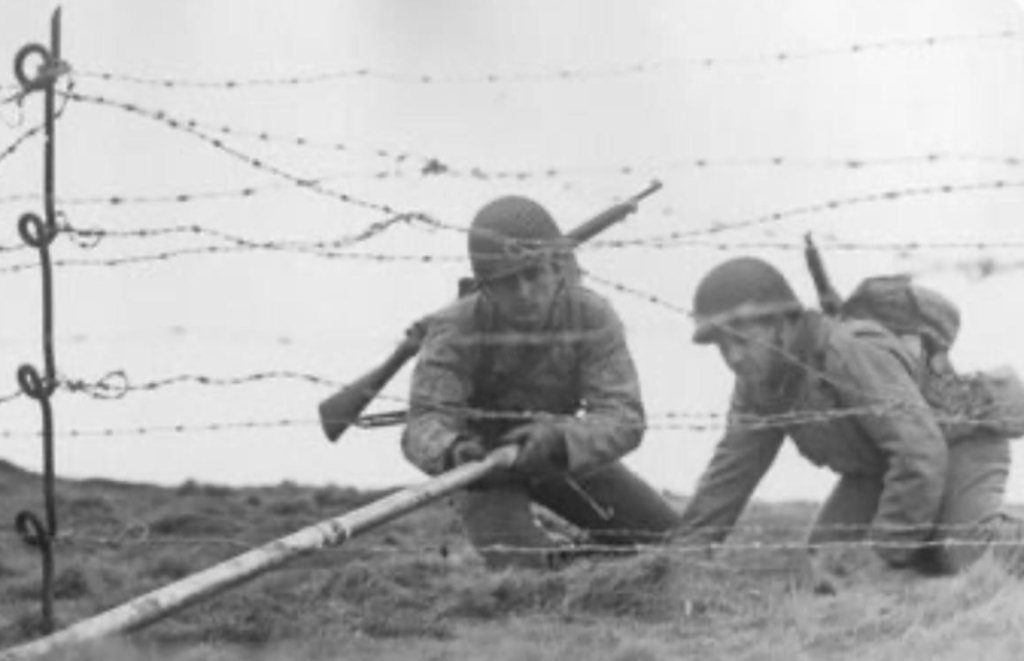
Bangalore Torpedos being tested in World War II.
The Bangalore Torpedo was invented in 1912 by Major R. L. McClintock, a British engineer stationed in Bangalore, belonging to the Madras Sappers and Miners – whose legacy is still evident across Bengaluru’s Ulsoor. The Sappers are military engineers, known in the United Kingdom as the Royal Corps.
However, its inspiration can also be traced back to Tipu Sultan of Mysore, famous for the military tactics he used to fend off British officers in the 18th century Carnatic, including for devising clever iron-cased rockets.

Early Beginnings of the Bangalore Torpedo.
Source: F.B Wilby, “Tests of the Bangalore Torpedo,” Professional Memoirs, Corps of Engineers, United States Army, and Engineering Department at Large, Vol. 6, No. 25, 1914.
The Bangalore Torpedo, both simple and ingenious, was used to clear barbed wire during trench warfare in World War I. As London’s Imperial War Museum describes, it consisted of “a number of externally identical lengths of threaded pipe, one of which contained the explosive charge. The pipes would be screwed together using connecting sleeves to make a longer pipe of the required length, and a smooth nose cone would be screwed on the end to prevent snagging on the ground. It would then be pushed forward from a protected position and detonated, to clear a path through barbed wire.” This made the Bangalore Torpedo an essential tool for breaching enemy defenses.
Three decades later, with the outbreak of World War II, the Americans adopted the explosive in even greater numbers and further developed them as part of their own arsenal, known as the Bangalore Torpedo M1A1. It was famously used during the 1944 D-Day landings on the beaches of Normandy in France, helping U.S. forces blast through German barbed-wire defenses, and as one of the largest sea-borne military missions ever, it became a crucial step in ultimately turning the tide of the war in favour of the Allied powers.
Modern renditions of the Bangalore Torpedos continue in military use today.
 prithvika prasad
Leave a comment